What will you receive in your geotechnical study report?
Discover exactly what a geotechnical report includes: stratigraphy, foundation parameters, the groundwater table and more. Comprehensive guide for homeowners.

Imagine that you hire someone to build the foundations of your house and that person tells you: "No need to look at the ground; I already know what the terrain is like here." That sounds absurd, doesn’t it? Well, that is exactly what happens when construction is carried out without a geotechnical study. And it happens more often than you think.
A geotechnical report is not just another bureaucratic formality. It is the document that determines whether your home will settle or sink, whether the foundations cost €20,000 or €80,000, and whether the concrete will last for decades or deteriorate in just a few years due to the aggressiveness of the groundwater. And yet many owners commission it without knowing what they are going to receive.
This guide exists precisely for that: so that when you open that dossier, you know how to read each section, understand why it is there, and can demand what is rightfully yours.
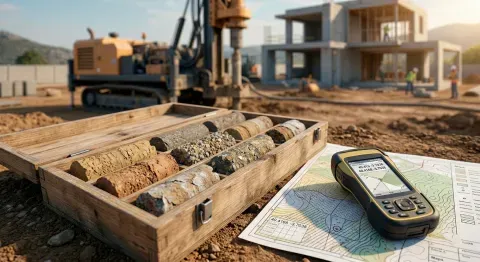
samples from geotechnical boreholes
A legal and technical document, not a simple summary
First of all, you need to understand that a geotechnical report is not a four-page PDF with photos of the ground. It is an exhaustive technical document with legal validity, mandatory for the construction of homes and regulated by the Technical Building Code (CTE), specifically its Basic Document on Structural Safety.
For it to have that validity, it must be signed by a competent professional—usually a geologist or a geologist engineer—and, in most autonomous communities, stamped (visado) by the relevant professional college. Without that signature and that stamp, your architect cannot attach it to the execution project, and the work lacks solid documentary support.
The geotechnical report is the instruction manual your architect needs in order to calculate the foundations without oversizing them or saving where it should not be saved.
This matters more than it seems. A report without a stamp can be rejected by the town hall, the insurer or the bank if you apply for a mortgage. And a poorly executed report—or directly falsified—can leave your architect without real data, with everything that implies for the safety of the structure.
👉 Who signs the geotechnical report and why does that signature change everything?
Anatomy of the report: what you will find section by section
A well-prepared geotechnical dossier has a predictable structure. Knowing it will help you spot whether something important is missing or whether the professional has done the bare minimum.
-
01
Descriptive report (memorandum)
Data about your plot: location, cadastral reference, general characteristics of the surroundings, and description of the proposed project (number of storeys, whether there will be a basement, estimated loads). This is the cover sheet for the work.
-
02
Fieldwork and laboratory work
The exact details of what was carried out on the ground: number of mechanical boreholes, static or dynamic penetration tests (SPT, DPSH), manual trial pits. It includes the exact coordinates of each test point and the laboratory analyses carried out on the samples extracted.
-
03
Stratigraphy and groundwater levelThe “section” of the subsoil: layer by layer, what materials are present (clays, gravels, rock), the thickness of each, and at what depth groundwater appears, if it exists. It is the three-dimensional map of the ground beneath your plot. -
04
Geotechnical parametersThe numbers that tell the whole story: allowable bearing stress of the ground, expansivity of the clays, aggressiveness of water and soil towards concrete, seismic coefficients according to the NCSE-02 regulations. This data is what the structural designer inputs into their models. -
05
Conclusions and foundation recommendationsThe most important section. The geologist specifies which type of foundation is most suitable (isolated footings, strip footings, foundation raft, piles), the exact depth at which it must bear, and what settlements—small differential sinkings—may be expected in the long term. -
06
Documentary annexesOfficial laboratory records, graphs of the boreholes (lithological columns), situation plans of the tests and photographic reporting of the fieldwork. Proof that everything stated in the report truly happened.
👉 How many boreholes does my plot need for the geotechnical study?
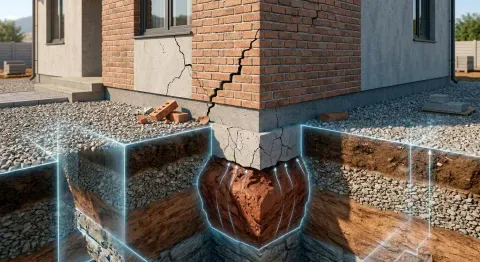
structural hazards of the house
The case that explains everything: when the ground lies
In a housing development on the outskirts of Valencia, a small developer decided to save money on the geotechnical study. They contracted the legal minimum: one borehole and one penetration test. The house was built on what appeared to be firm ground. Two years later, cracks appeared in the façade. The diagnosis: a pocket of expansive clay not detected below the foundation level. The cost of the structural repair exceeded the original budget for the foundations.
The parameter that would have prevented all of this is the expansivity index of the clays, which appears in the geotechnical parameters section. A single laboratory test on the sample extracted during the borehole. Test price: less than €200. Cost of not doing it: tens of thousands.
Key data
The allowable bearing stress of the ground can vary from 0.5 kg/cm² in soft clays to more than 4 kg/cm² in sound rock. That difference can triple the cost of the foundations if it is not detected in time.
👉 How does allowable bearing stress affect the foundation budget?
Three things you should check before accepting the report
Not all reports are the same. Some studies are carried out rigorously, while others do the bare minimum to meet the paperwork requirements. Before you consider the document you receive as valid, check these three points:
1. Coordinates of the test points. Each borehole, trial pit or penetration test must have exact UTM coordinates in the report. If they are not shown, there is no way to verify that the work was carried out where it says it was. It is the equivalent of a medical blood test failing to identify the patient.
2. Original laboratory records. The geotechnical parameters must be supported by the corresponding laboratory tests. If the report includes strength or expansivity values but there are no attached records, those data lack traceability.
3. Recommendation for foundation level. This is the piece of information with the greatest impact on the construction budget. It must appear explicitly, with a specific depth. A report that says “it is recommended to found on the competent stratum” without specifying the level is ambiguous and incomplete.
👉 What is the foundation level and why does it matter?
A geotechnical report without laboratory records is like a blood test without reference values: it has the form of a technical document, but it lacks real validity.
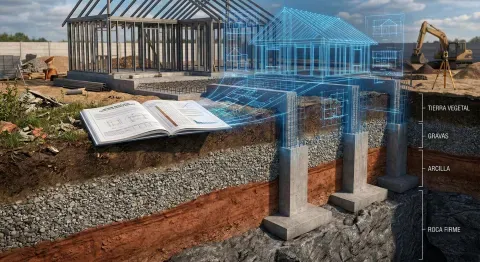
Now you know what you have to demand
A geotechnical report is not a cost. It is the investment that protects all the other costs of the project. Once you know what type of ground you have, at what depth the water is, and what bearing stress the soil can withstand, your architect can size the foundations with surgical precision: neither more nor less than what is necessary. That translates directly into money.
And now that you know the anatomy of the document, you can read it with different eyes. Not as a bureaucratic requirement you sign without understanding, but as the map that determines the safety and cost of your future home.
The next step is clear: if you still do not have your geotechnical study, or if you have doubts about whether the one they provided you includes all the sections we have seen here, it is time to resolve it.
Do you need your geotechnical report?
Request a quotation with no obligation. We will explain exactly what your study will include and on how many days you will have it ready and stamped (visado).
Request a quotation in the form →
Do you need a geotechnical study?
Request a no-obligation quote. We’ll advise you on the type of study you need.
- Studies signed by a licensed geologist
- Compliant with the CTE and Eurocode 7
- Coverage throughout Spain


Más de 1000 estudios realizados
Request a free quote
We can contact you via WhatsApp, phone, or email, whichever you prefer.


