How does the allowable bearing pressure affect the foundation budget?
The permissible ground stress determines the type of foundation and its actual cost. Practical examples for owners who want to avoid surprises on site.

There is a number in the geotechnical report that your architect looks at before any other. It is not the depth of the groundwater table, nor the type of clay, nor the seismic coefficients. It is a value expressed in kilograms per square centimetre or in kilopascals, and it determines—more than any other piece of information—how much you are going to pay for the foundations of your home. It is called the admissible bearing pressure of the ground, and most homeowners do not even know it exists until the construction budget gives them a shock.
Understanding what that number is, what causes it, and how it governs your architect’s decisions does not require engineering knowledge. It requires knowing how to ask a simple question: how much load does my ground withstand for each square centimetre of surface? The answer to that question can mean the difference between a conventional foundation of €18,000 and a special foundation of €60,000. And that difference is revealed by the geotechnical report, not the build.
What admissible bearing pressure is and why it decides everything
Admissible bearing pressure is the maximum load that the ground can support per unit area without excessive settlement or rupture of the soil occurring. Put more directly: it is the weight limit the ground can bear before it yields in an unacceptable manner under the foundations.
This value is not uniform. It varies enormously depending on the type of material that makes up the subsoil. Sound rock can have admissible pressures higher than 5 kg/cm². A compacted gravel can range between 2 and 4 kg/cm². Loose sand drops to values between 1 and 2 kg/cm². And soft clay can be below 0.5 kg/cm², which in practical terms means the ground barely bears load before deforming.
What makes this parameter so relevant is its direct relationship with foundation sizing. If the ground can support only a small load per unit area, the solution is to increase that area: larger, deeper foundations, or a completely different foundation typology. And more foundation area means more excavation, more concrete, more steel, and more time on site.
👉 What does a geotechnical report contain?
"Admissible bearing pressure is not an academic figure: it is the parameter that determines how many cubic metres of concrete your house will need before the first brick is placed."
The architect or structural engineer takes this value from the geotechnical report and incorporates it into their calculations to size each foundation element. Without that data, any structural calculation is a blind estimate. With it, the sizing is accurate and justified.
👉 How many boreholes does my plot need for the geotechnical study?
How the budget changes according to the ground value
The relationship between admissible bearing pressure and foundation cost is not linear: at its extremes it is exponential. To understand it, it helps to look at three real scenarios that are frequently repeated in single-family housing projects.
Competent ground: high admissible bearing pressure
A plot over compacted gravels or sands with an admissible bearing pressure of 2.5 kg/cm² allows the foundation of a two-storey single-family home to be solved with isolated or strip footings at shallow depth. Excavation is minimal, the concrete volume is controlled, and execution time is short. Indicative foundation budget: between €15,000 and €25,000.
Intermediate ground: moderate admissible bearing pressure
A firm clayey soil with an admissible bearing pressure of 1 kg/cm² forces the base of the footings to be widened or the use of a raft foundation that distributes the loads over a larger area. Excavation is deeper, shuttering is more complex, and the concrete volume multiplies. Indicative budget: between €25,000 and €45,000.
Problem ground: low admissible bearing pressure
Soft clay or an anthropogenic fill with an admissible bearing pressure below 0.5 kg/cm² makes any shallow foundation unfeasible. The usual solution is piles, which transfer the loads to a competent stratum at greater depth. The execution requires specialised machinery, the construction time increases, and the cost shoots up. Indicative budget: between €45,000 and €90,000.
KEY FACT: A variation of 1 kg/cm² in admissible bearing pressure can mean a difference of €20,000 to €40,000 in the foundation budget for a standard single-family home. That margin is known before work starts if you have the geotechnical report. Without it, it is discovered during excavation.
The case of the architect who avoided a disaster with a single number
On a plot on the coast of Almería, a homeowner had received two very different foundation quotes: one for €22,000 and the other for €38,000. The cheaper option used isolated footings at a depth of 80 centimetres. The more expensive one proposed a raft foundation at 1.2 metres.
The difference in approach between the two estimators was a single piece of data: the admissible bearing pressure of the ground. The first had estimated the value based on the visual appearance of the soil during the site visit. The second had waited for the geotechnical report, which revealed a layer of low-consistency silts under the first 60 centimetres of soil that was apparently firm. The real admissible bearing pressure was 0.8 kg/cm², not the 2 kg/cm² that the first estimator had assumed visually.
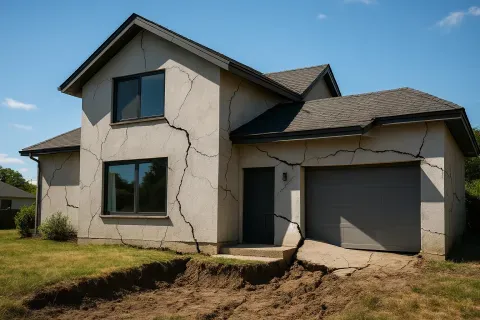
The €38,000 raft was the correct solution. The €22,000 footings would have generated differential settlements within a few years, with the corresponding structural cracks. The geotechnical report, which cost €900, prevented an incorrect foundation decision with a potential impact of tens of thousands of euros in repairs.
👉 Who signs the geotechnical report and why does that signature change everything?
"Estimating admissible bearing pressure by eye during a plot visit is as reliable as estimating the strength of a beam by looking at it from the pavement. The real number is only given by testing."
Three questions you should ask when you see that number in the report
When your architect shows you the geotechnical report and points out the admissible bearing pressure value, do not just nod along. Ask these three questions:
- At what depth is that value valid? Admissible bearing pressure always refers to a specific stratum at a specific depth. A high value at three metres depth may be irrelevant if the foundation will bear at a depth of one metre. Make sure the data corresponds exactly to the level where the foundation will be placed.
- Is there lateral variability in the ground? If the boreholes show significant differences between points, admissible bearing pressure may not be uniform beneath the whole footprint of the dwelling. In that case, the foundation may need to be adapted zone by zone, which complicates and increases the cost of the design.
-
What settlements are expected in the long term? Admissible bearing pressure ensures that there will be no rupture of the ground, but it does not imply that there will be no settlement. The report should include an estimate of the total and differential settlements expected, because excessive differential settlement can cause structural damage even if the ground has not reached its rupture limit.
👉 What is the foundation level and why does it matter?
The number that deserves all your attention
Of all the data contained in a geotechnical report, admissible bearing pressure is the one that has the most direct and immediate economic consequences for your project budget. It is not the only important parameter—among other things, the expansivity of clays, the aggressiveness of water, and seismic coefficients also matter—but it is the first your architect consults and the one that most influences their design decisions.
Knowing it before construction starts is not a technical advantage reserved for professionals. It is information that any homeowner can understand and use to make more informed decisions, compare budgets with a sound basis, and avoid the surprises that turn a project into a financial nightmare.
The next step is clear: if you still do not have that number for your plot, every week that passes without the geotechnical report is a week in which any decision about your foundations is being made blindly.
Obtain the admissible bearing pressure of my ground by filling in the form →
Do you need a geotechnical study?
Request a no-obligation quote. We’ll advise you on the type of study you need.
- Studies signed by a licensed geologist
- Compliant with the CTE and Eurocode 7
- Coverage throughout Spain


Más de 1000 estudios realizados
Request a free quote
We can contact you via WhatsApp, phone, or email, whichever you prefer.


