What does the CTE validate in a geotechnical study, and what happens if it is not complied with?
What the CTE requires of a geotechnical study for it to be valid: minimum content, ground classification, and when it is mandatory by regulation.

CTE building technical code
There is widespread confusion among property owners who are about to build their home. Many believe that the geotechnical study is a requirement that can be satisfied by any document bearing that name. That it is enough to have a signed sheet from someone who has looked at the ground. That the town hall will not review the contents in detail. That belief is costly. Not because the town hall always rejects deficient reports—sometimes it does not review them in depth—but because the architect, the structural designer and the insurer do. And when a report does not meet what the Technical Building Code requires, the chain of responsibilities breaks exactly where it hurts most: at the foundations.
The CTE is not a suggestion. It is the regulatory framework governing building safety in Spain, and its Basic Document for Structural Safety sets out precisely what a geotechnical study must include to be valid, what classifications it must apply, and in which cases it is mandatory to carry it out. Knowing that framework turns you into an owner who can demand what is correct from the outset, not one who discovers shortcomings once the work is already under way.
"A geotechnical report that does not cite Annex B of the DB-SE or does not apply its classification is not failing a formality: it is ignoring the regulatory framework that gives the document legal validity."
What the DB-SE is and why the reference that matters
The Technical Building Code is organised into Basic Documents, each dedicated to a specific safety requirement. The one that regulates geotechnics is the Basic Document for Structural Safety, known as DB-SE, and within it the Annex B is the chapter that sets out the specific requirements for geotechnical investigation.
This annex is not guidance. It defines specific obligations: what minimum information must be collected, how the ground must be classified, how many recognition points are required depending on the type of work, and which parameters must be determined for the report to be technically valid. When a technician drafts a geotechnical report to attach to an execution project in Spain, Annex B of the DB-SE is the standard against which that document is measured.
There is also other legislation that complements the CTE in specific aspects. The Earthquake-Resistant Construction Standard NCSE-02 sets out requirements for geotechnical characterisation of the ground in areas with relevant seismic acceleration, and compliance forms part of the scope of many geotechnical reports. In works involving retaining elements—walls, basements, slopes—the legislation on Reinforced Concrete Structures EHE-08 also comes into play, which requires knowing the chemical aggressiveness of the ground and of groundwater in order to specify correctly the type of cement and the durability of the concrete.
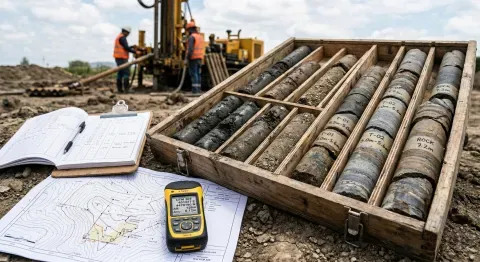
👉 What does a geotechnical report contain?
The two classifications that the CTE requires to be applied
The core of Annex B of the DB-SE consists of two classifications that the technician must assign to each case before determining the scope of the investigation. They are the basis on which everything else is built.
Ground classification: T-1, T-2 and T-3
The CTE establishes three ground groups according to their geotechnical complexity. The Group T-1 groups favourable grounds: low variability, no special problems, predictable behaviour materials such as compacted gravels or cohesive soils in a firm state. Group T-2 covers intermediate grounds, with some variability or materials that require more attention. The Group T-3 includes unfavourable grounds: soft or expansive clays, made ground, grounds with the presence of water, karst, or any condition that implies a special geotechnical risk.
This classification is not a subjective assessment by the technician: it must be justified by the field and laboratory data collected by the report itself. A ground classified as T-1 without data to support it is a classification without technical basis.
Building classification: C-1, C-2 and C-3
At the same time, the CTE classifies buildings according to their scale and structural complexity. The Type C-1 includes small-dimension constructions: single-family dwellings of one or two storeys, retaining walls of less than three metres. The Type C-2 comprises buildings between three and ten storeys and structures of moderate complexity. The Type C-3 are large buildings, special projects, or those with especially significant loads.
The combination of the ground classification and the building type generates a matrix that determines the minimum number of recognition points, the minimum depth of the boreholes and the mandatory laboratory tests. It is not optional: it is the normative minimum that any report must meet in order to be valid.
👉 How many boreholes does my plot need for the geotechnical study?
KEY FACT: A two-storey single-family home on unfavourable ground (C-1 + T-3) requires twice the number of recognition points and a greater borehole depth than the same home on favourable ground (C-1 + T-1). If your report does not reflect that difference and applies the same scope to both cases, you are failing to comply with the CTE.
"If the town hall accepts a report, that does not mean the report complies with the CTE. Administrative control and technical rigour are two different filters, and the second one is the one that protects your investment."
The case of the report that passed the municipal filter but not the architect’s
In an urbanisation in the province of Seville, a property owner submitted their project to the town hall with an attached geotechnical report. The municipal technician accepted the documentation without objections. The project obtained a licence. Everything seemed to be in order.
When the architect preparing the project tried to use the data from the report to justify the foundation calculations, they found that the document did not include the ground classification according to Annex B of the DB-SE, did not specify the recommended foundation level, and the laboratory tests were limited to a particle size analysis without determining Atterberg limits or expansiveness.
The report had passed administrative control, but it was not suitable for what really matters: giving the structural designer the data they need to size the foundations safely and with regulatory justification. The architect had to request a supplementary report with the missing tests. Additional cost: €650, plus the three-week delay in the start of the works.
👉 What is the foundation level and why does it matter?

What the report must include to comply with the CTE: the checklist
A geotechnical report that complies with Annex B of the DB-SE must contain, as a minimum, these verifiable elements:
- Explicit classification of the ground and the construction. The report must explicitly assign the corresponding T and C groups and justify them using the data obtained. If those letters and numbers do not appear with their justification, the report does not apply the CTE methodology.
- Number of recognition points in accordance with the normative matrix. The T+C combination determines a minimum number of points. The report must state how many have been carried out and why that number is sufficient for the specific case.
- Complete geotechnical parameters. Allowable stress of the ground, deformation modulus, cohesion, internal friction angle and, where applicable, expansiveness index and chemical aggressiveness. These values must be supported by the corresponding laboratory tests.
- Recommended foundation level with an explicit numerical value. Not a description of the competent stratum: a depth in metres referenced to the ground surface level or to an identifiable fixed point.
- Detected groundwater table level or justification of its absence. If groundwater has not been detected, the report must indicate at what depth the boreholes were explored and why it is concluded that the groundwater table is below that level.
- NCSE-02 compliance where applicable. In municipalities with seismic acceleration equal to or greater than 0,04g, the report must include soil characterisation for seismic purposes, with the classification of the ground type according to the seismic-resistant standard.
👉 How does allowable stress affect the foundation budget?
When the geotechnical study is mandatory under the CTE
The CTE leaves no room for interpretation on this point. The geotechnical study is mandatory for any new-build project that requires a technical project. This includes all single-family dwellings, regardless of their size, number of storeys or apparent constructive simplicity.
There is no exemption for being a small construction, for knowing the ground well in the area, or for having built similar buildings on nearby plots. Each plot is a different case, and the CTE acknowledges this by requiring a specific investigation for each project.
The only practical exceptions are works that do not require a technical project—for example, small internal refurbishment works—but as soon as the intervention involves new structure or new foundations, the geotechnical study is mandatory. Building without it is not only technically risky: it is a regulatory infringement that can have consequences for the ten-year insurance of the building and for any subsequent claim for structural pathology.
👉 How does allowable stress affect the foundation budget? What nobody tells you: Why you need a soil study before building your house?
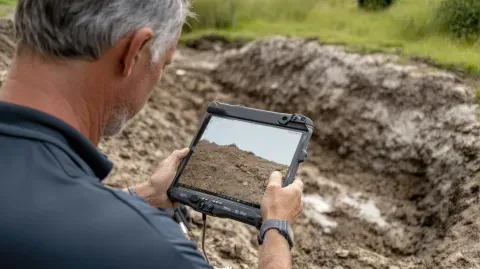
Examining the ground
Regulations are not the enemy: they are your guarantee
It is tempting to see the CTE as bureaucracy that makes the building process more complicated and more expensive. But Annex B of the DB-SE exists because before it was introduced, there were buildings with poorly sized foundations, dwellings with structural cracks, and owners who ended up paying twice for the same work.
Regulations do not protect the town hall or the professional association. They protect you. When you require the geotechnical report to comply with the CTE, you are not being demanding out of technical whim: you are ensuring that the document that will guide the foundations of your home has the regulatory backing, methodological soundness and legal traceability that an investment of that scale deserves.
The next step is concrete: before accepting any geotechnical report, check that it includes the T and C classification from Annex B, the complete parameters and the foundation level in metres. If any of those elements is missing, the report is incomplete. And completing it before the works start is always cheaper than doing it afterwards.
Request a geotechnical study in accordance with the CTE →
Do you need a geotechnical study?
Request a no-obligation quote. We’ll advise you on the type of study you need.
- Studies signed by a licensed geologist
- Compliant with the CTE and Eurocode 7
- Coverage throughout Spain


Más de 1000 estudios realizados
Request a free quote
We can contact you via WhatsApp, phone, or email, whichever you prefer.


