
Geotechnical study in Creixell
Do you need a Geotechnical study?
Find the best price and service in Creixell. Get a free quote.
More than 1000 geotechnical studies carried out
Approximate price 750€
We can contact you via WhatsApp, phone, or email, whichever you prefer.
Comprehensive Geotechnical Studies
We combine field analysis and laboratory testing to provide accurate technical reports and foundation solutions.


Expert professional
Technicians with more than 15 years of experience in the industry. We are specialists in access to difficult locations such as sites with level changes, basements, etc.
Accredited
Geotechnical calculations comply with the rules established by Eurocode 7, UNE-EN ISO 22476-4:2016.

Best price
Very competitive prices. The best prices for geotechnical studies in Spain. Request a quote and check it.
Speed and quality
Within 7 to 10 days you will receive a signed report from a geologist. It is mandatory in order to carry out new construction or refurbishment works that involve modifications to the structure.

Work areas
We provide Geotechnical study in all localities of Creixell.
This includes the following geographical areas: Province of Barcelona, Girona Province, Province of Lleida, Province of Tarragona, Cataluña and surrounding areas.
We come to your home in Creixell whenever it suits you, arranging a day and time.

Types of ground in Creixell
In Creixell, the predominant substrate consists of limestones, dolomites and marbles, together with compact gravels and sands, which provides competent soils with good bearing capacities for shallow or semi-deep foundations. However, the occasional presence of deltaic silts and peats recommends avoiding these materials as a supporting base due to their low strength. Additionally, the occurrence of gypsum, anhydrite and salts raises potential dissolution problems, which must be taken into account during geotechnical investigations prior to the design of foundations.
The seismicity in Creixell is very low, with only 6 events over 30 years and a maximum magnitude of 2.1, so it does not represent a noteworthy constraint for structural design. However, the potential development of karst processes in the carbonate substrate requires a detailed verification of the presence of cavities or sinkholes before carrying out any foundation. As it is a non-clayey substrate, the risk of expansivity is ruled out, with control of the karst being the main geotechnical constraint in the area.
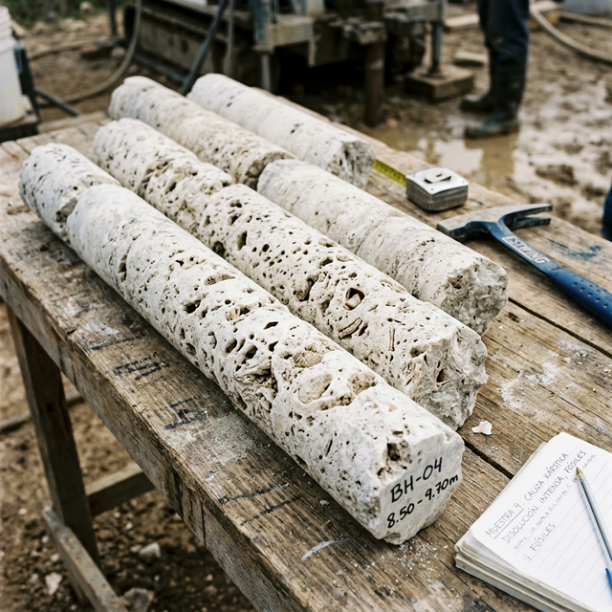
Limestones, Dolomites and Marbles
karstic structures (caves, sinkholes, dolines) that pose the main geotechnical risk.
View details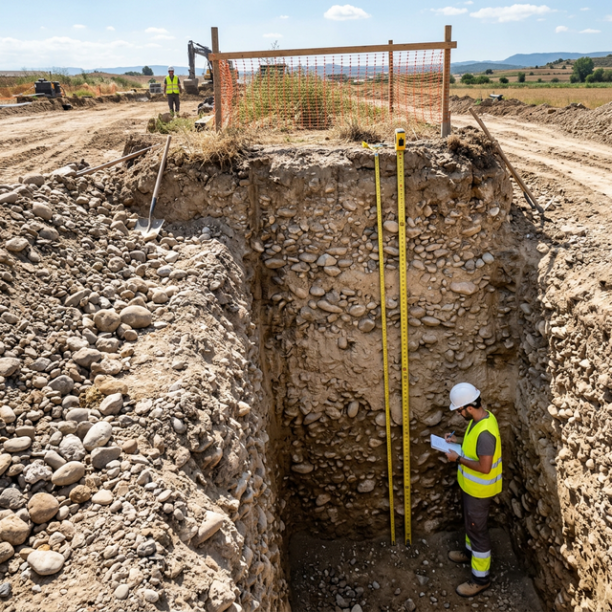
Compact gravels and sands
High-compacity granular deposits, typically associated with old fluvial terraces (Ebro, Duero, Tajo, Guadalquivir rivers) and Pleistocene glacis. They have no cohesion (they are not clays) but their a
View details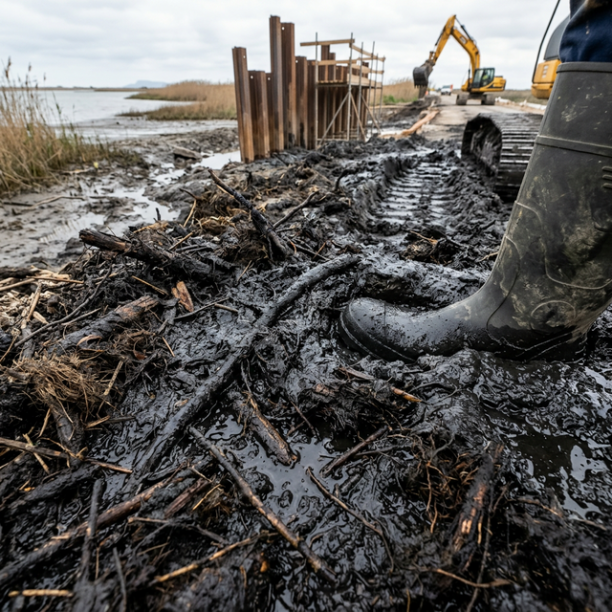
Fangy clays and peats (Deltaic)
Soils from the Holocene period, unconsolidated, flowing muds, black in colour with a very strong organic component, sometimes in the form of pure rotting vegetable matter (peat bogs). The mud compress
View details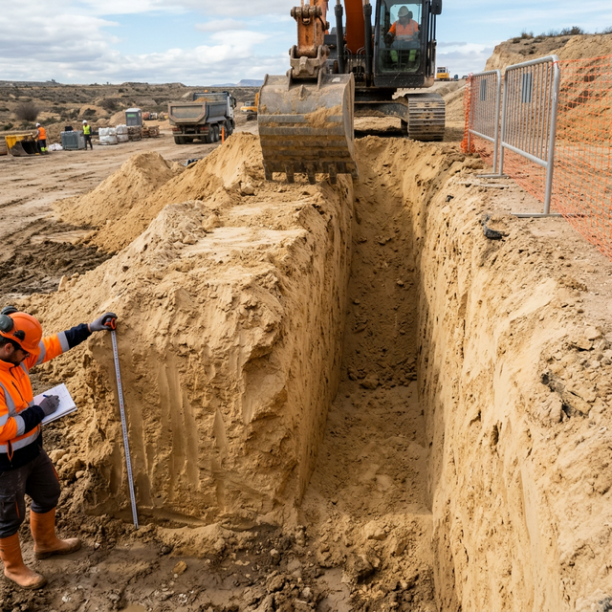
Fine sands and silts
Fine to very fine granular soils with medium to loose compacity. Typical of floodplains and coastlines. Although they can support light buildings, they are treacherous soils linked to water processes:
View details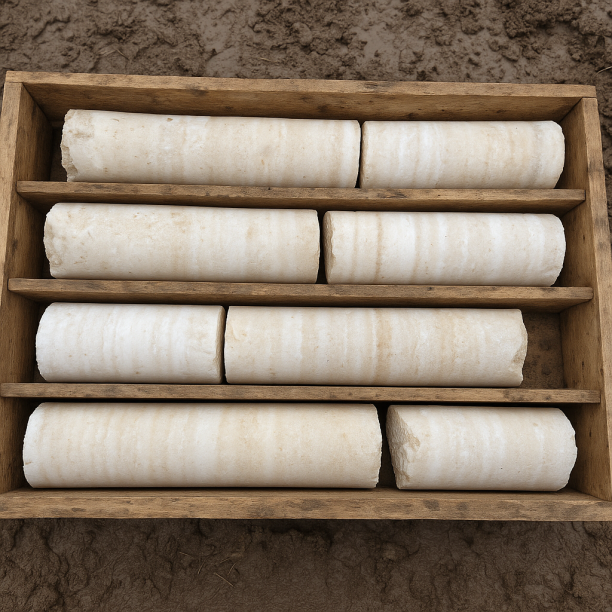
Gypsum, Anhydrite and Salts
Chemically formed sedimentary rocks produced by the precipitation of minerals dissolved in closed basins. Gypsum predominates (calcium sulphate) and, to a lesser extent, anhydrite and salts (halite).
View detailsConstruction risks in Creixell
Approximate estimates. They do not replace the geotechnical study.
| Soil type | Expansivity | Settlements | Water table | Seismicity | Minimum foundation |
|---|---|---|---|---|---|
| Limestones, Dolomites and Marbles | None | Media | Media | Downward | In general, direct foundation using braced strip footing... |
| Compact gravels and sands | None | Downward | High | Downward | Conventional shallow foundation without problems. Raft f... |
| Fangy clays and peats (Deltaic) | Downward | High | High | High | Inviable with any natural means. Drive tests of enormous... |
| Fine sands and silts | None | High | High | High | To avoid local punching, the foundation slab is used ext... |
| Gypsum, Anhydrite and Salts | Media | High | High | Media | The foundation must be designed to withstand local loss ... |
Interactive geological map · Creixell
Mapping: IGME GEODE 50k · IGME MAGNA 50 · ICGC (Catalonia)
Geological Viewer
IGME · ICGC- Click on the map to see the geology at the point.
- Use the layer buttons to switch between geological views (GEODE, MAGNA, Lithology, Hydrogeology).
- Adjust the opacity of the geological layer with the control below.
- Press the full-screen button to expand the viewer.
Geological information
Typical stratigraphic profile
Indicative subsurface cross-section in Creixell · Based on GEODE soil types
Indicative profile based on GEODE soil types and typical CTE thicknesses
Seismic risk in Creixell
- 1 M 2.1 2010
- 2 M 2 2007
- 3 M 1.7 2009
How do we carry out your geotechnical study?
Step
Free quote
Request a quotation for your geotechnical study. Completely free and with no obligation.
Step
We arrange a day
We are looking for a day and time to carry out the field study.
Step
Conducting the geotechnical study
We’re going to move and carry out the study. In an hour or two we’ll have finished.
Step
Report submission
Within a week we will send you the signed documents of the geotechnical study by an accredited geologist.
Also available in
Spain’s most populated cities
Useful information about Geotechnical study
In-depth articles


Entities and institutions