El Catllar, where the rock rules from the castle to the church
A sandstone promontory rising above the Tarraconensian plain is not just a landscape: it is the reason why El Catllar exists where it does, and also why its oldest buildings share materials with the ground that supports them.

Los muros del castillo de El Catllar nacen directamente del afloramiento rocoso del cerro, haciendo casi indistinguible la frontera entre roca natural y piedra trabajada.
There is a detail that goes unnoticed by anyone who reaches the old centre of El Catllar for the first time. The walls of the castle do not begin where the ground ends: they spring from it. The base stones, ochre in colour and with a granular texture, are practically indistinguishable from the rocky outcrop on which they sit. The fortification and the hill are, literally, the same material. At some point in the Middle Ages, someone looked at that promontory and understood that the land offered them something that did not need to be manufactured: an elevated, resilient platform already raised by the local geology itself.
El Catllar is located in the Camp de Tarragona, a coastal plain that rivers and time have been covering with sediments. But in some parts of that plain there rise modest elevations, small hills where erosion has exposed materials that are harder and therefore resist wear better. One of those points is the turó on which the historic core of El Catllar was built. From there, the surrounding visual domain is immediate: the agricultural plain stretches in every direction, and any movement across it is visible.
There is no documentation establishing exactly when that hill was chosen as a point of watch or control. But the logic of the terrain speaks for itself. A ground of fine sands and silts —such as characterises most of the municipal area of El Catllar— offers no firm resistance to high-rise construction or any defensive advantage. The fine material compacts under weight, gives way, and shifts with water. A wall built on such ground needs deep foundations and becomes vulnerable. The rocky hill, by contrast, is stable, raised and dry. The choice of that point, although no document explains it, is consistent with the decisions that medieval builders made again and again across Catalonia: look for the rock, climb onto it, build on top of it.
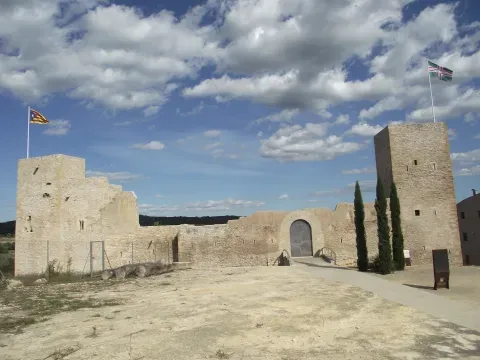
Vista general del castillo de El Catllar sobre el promontorio rocoso que ha determinado la posición del asentamiento histórico.
What remains today of the castle of El Catllar are remnants, not an intact monumental ensemble. The former possession of the counts of Santa Coloma suffered the passage of time and the transformations that every feudal structure undergoes when the function that justifies it disappears. But those remains are enough to read the original argument: the tower on the rock, the walls that follow the line of the outcrop, the dominant position over the hamlet that grew up at its feet. The castle was not on the hill despite the stone. It was there precisely because of it.
The stone that goes down to the town
Observe the build of the walls: that warm-toned sandstone that appears in the castle reappears in the constructions of the old town core, in the jambs of the older doorways, in the plinths of the houses that adjoin the base of the hill. This is not an aesthetic coincidence. It is the result of elemental construction logic: when building material is within reach —literally in the ground beneath one’s feet— it is extracted and used. Transporting stone has a cost. Cutting it from the local outcrop has a much smaller one.
Sandstones are sedimentary rocks formed by sand grains cemented together. Their behaviour under the chisel depends on the type of cement that binds those grains: if it is calcareous, the rock can be worked with relative ease and allows regular cuts; if it is siliceous, it is harder and more resistant to wear, though also more difficult to carve. The sandstones of the Camp de Tarragona belong to the first type, which makes them a valued material for construction: manageable, locally available, able to provide blocks of useful dimensions. The walls of the castle of El Catllar show this work: stones cut with sufficient regularity to raise vertical faces without excessive waste of material.
This same logic —local rock, nearby extraction, immediate use— also explains why the historic core of El Catllar has a visual coherence that villages built on softer ground sometimes fail to achieve. When all the buildings from a single generation share the material of the subsoil, the result is a uniform tonal palette. The colour of the ground rises up the walls.
The ground that surrounds the hill
Outside the hill, El Catllar’s territory is something else. The fine sands and silts that cover most of the municipal area are the result of fluvial and aeolian sedimentation processes that, over millennia, have deposited light materials over the plain. This soil has characteristics that matter to those who build or cultivate on it.
Ground types in El Catllar
Characteristic soils in the area, ordered by relevance.
-
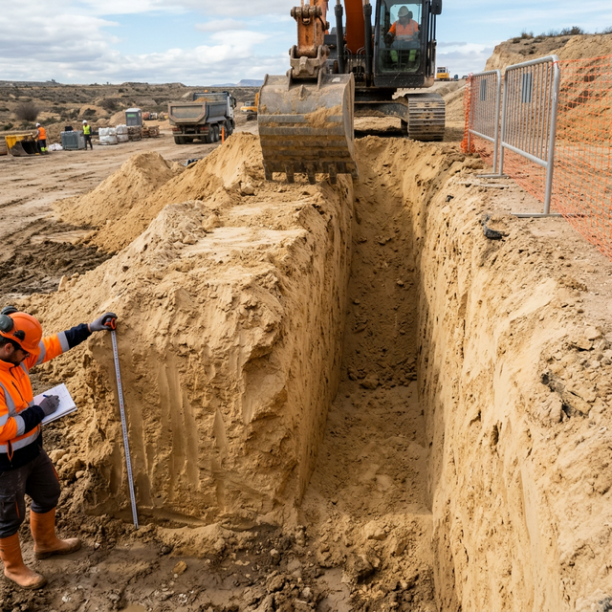
Fine sands and silts
Fine to very fine granular soils with medium to loose compacity. Typical of floodplains and coastlines. Although they can support light buildings, they are treacherous soils linked to water processes:
View details
Fine sands and silts have permeability that deserves attention. The ground around El Catllar consists of formations of low permeability at the surface, meaning that water tends to circulate slowly through them and may accumulate at depth in aquifers with higher yields. For an agricultural community, that has direct consequences: the soil retains moisture for longer than a very permeable ground, but it can also become waterlogged if rainfall is intense. For those who build, it implies that any substantial work on these soft materials requires foundations that reach more firm levels, something that, at the scale of popular historic architecture, was resolved with wide base walls and robust ground floors.
The absence of expansive clays in El Catllar’s subsurface is, in its own way, good geological news. Expansive clays are materials that absorb water and increase in volume, and then contract as they dry out. This cycle of expansion and contraction generates stresses in foundations and can crack buildings with inexorable slowness. With a non-clayey substrate beneath the near-surface ground, El Catllar is spared that chronic problem affecting other inland localities of Tarragona.
1776: building on what has already been built
There is another building in El Catllar that deserves attention before going further: the parish church of Sant Joan Baptista. Construction works on that temple began in 1776, and were carried out on the remains of an earlier place of worship. This was not an unusual practice: religious sites tended to persist in the territory even when the building that occupied them was demolished or collapsed. The continuity of the sacred place was, in many cases, more important than the continuity of the architecture.
What is significant, however, is the material chosen for the new construction. The church of Sant Joan Baptista, with its orderly ashlar facade and its octagonal tower that dominates the square, is built using the same calcareous sandstone that characterises the hill and the castle. In 1776, the builders of El Catllar continue to use local stone. Not because there were no alternatives —the 18th century in Catalonia knew other materials— but because the local rock was still the most reasonable option for a community that lacked the means to import building materials on a large scale.
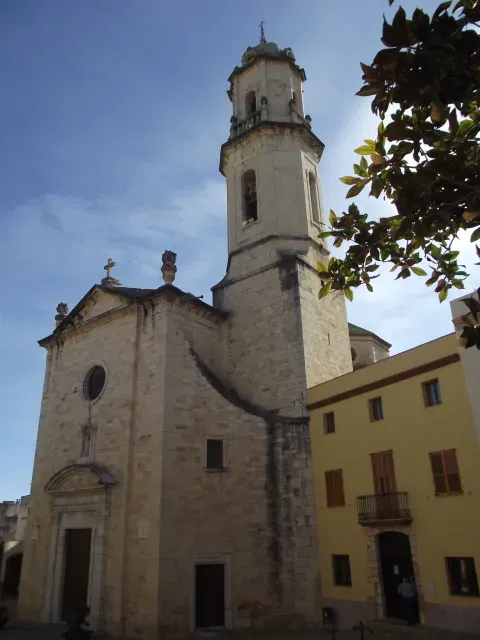
La iglesia parroquial de Sant Joan Baptista, cuyas obras comenzaron en 1776, construida con la misma arenisca local que el castillo medieval que domina el cerro sobre el pueblo.
The church’s fabric records that decision in every course of its walls: sandstone blocks cut with greater precision than those of the medieval castle, reflecting both the evolution of stonemasonry techniques and the different purpose of the building. A castle demands strength; an 18th-century parish church also demands representation. The ashlar of Sant Joan Baptista is more regular, more whitened by time, and more carefully arranged. But the stone is the same.
Nearly a century later, in 1850, the chapel of the Blessed Sacrament is added to the ensemble, separated from the main temple. The construction sequence of El Catllar —medieval castle, church in 1776, chapel in 1850— describes three distinct moments in the locality’s history written with the same material. The rock of the hill acts as an invisible thread running through that story.
Water and industry on the plain
While the hill concentrated power and religion, the plain around El Catllar had its own logic. Soils of fine sands and silts, apparently less noble than the promontory’s rock, were in fact the ones that made agriculture possible. The Camp de Tarragona plain was historically a territory of vineyards, olive groves and cereals, and the sedimentary soil surrounding El Catllar shared in that general agricultural vocation.
There is a detail that reveals the industrial scale that the territory came to reach: the paper mill. The building, now in ruins, with its brick chimney that still rises above the construction remains, recalls that El Catllar once had some manufacturing activity linked to water. Paper mills need water in large quantities with a sufficiently constant flow. The surrounding low-permeability ground, capable of feeding aquifers at depth, could have favoured the existence of watercourses or springs that made that activity viable. The brick chimney —a different, industrial material, alien to the sandstone of the hill— marks the moment when El Catllar stops being built only with what lies beneath it, and begins to incorporate materials from another source.
The hill, once again
Now return to the castle. Look at the base of the walls, where stone worked by human hands blurs into the natural outcrop. This continuity between rock and wall is not an accident of later erosion, nor the result of time levelling them out. It is the starting point. Someone chose that hill because the stone was already there, raised, firm and visible from the plain. Then came the castle, then the village at its feet, then the church with the same stone cut more carefully, then the chapel, then the mill with its chimney that no longer speaks of sandstone but of brick and steam.
Each of those layers is written on the same territory. The hill remains the highest point of the old settlement. The sandstone remains the dominant colour of its oldest walls. And the plain of sands and silts stretching around it remains the ground on which everything else grew: the fields, the houses, the industry, and the contemporary expansion of the municipality. Geology does not explain everything about El Catllar. But it does explain why the village is where it is, why its oldest buildings have that colour, and why the line separating rock from wall in the castle is so difficult to find.
Do you need a geotechnical study in El Catllar?
Request a no-obligation quote. We’ll advise you on the type of study you need.
- Studies signed by a licensed geologist
- Compliant with the CTE and Eurocode 7
- Coverage throughout Spain


Más de 1000 estudios realizados
Request a free quote
We can contact you via WhatsApp, phone, or email, whichever you prefer.


