Guide to carry out a geotechnical study: Key steps and recommendations
When planning any construction project, carrying out a suitable geotechnical study is essential to determine the ground’s suitability and ensure the structural stability of the building. Although it may sound complex, understanding its basic stages can help you commission this service with knowledge and confidence. Below, we present a simple yet comprehensive guide so that you know what each phase of the geotechnical investigation involves and why it is so important.

1. What is a geotechnical study and why is it important?
The geotechnical study is the process of analysing the physical and mechanical properties of the soil on a specific site. Its main objective is:
-
Assess the bearing capacity and strength of the soil.
-
Identify potential risks, such as the presence of groundwater or instability on the site.
-
Recommend the type of foundation most suitable for the project.
In addition to enabling a safe and cost-effective design for construction, the study results prevent future problems, such as cracking, excessive settlement or collapse, thereby avoiding costly cost overruns or repairs later on.
2. Planning and collection of prior information
Before starting fieldwork, it is essential to gather all available preliminary information:
-
Existing documentation: Review topographic plans, previous studies or old reports that may provide data about the area.
-
Climatic and geological characteristics: Understand the climate, rainfall regime and the region’s geological formation.
-
Local regulations: Ensure compliance with the specific legal regulations and requirements of the place where construction will take place.
This planning phase not only speeds up the process, but also optimises resources and ensures that geotechnical investigations are carried out as efficiently as possible.
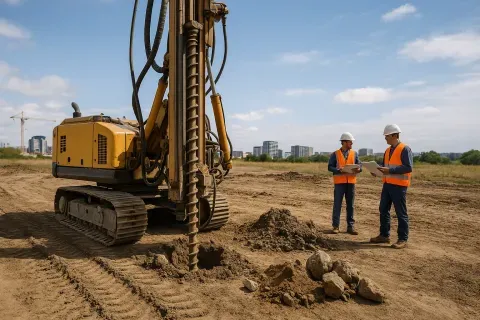
3. Fieldwork: Boreholes and sampling
Fieldwork is essential in order to obtain representative soil samples and to understand in detail their composition. The most common steps are as follows:
3.1 Geotechnical boreholes
Using specialised machinery, the ground is drilled to the required depth (typically down to the planned foundation level). During the process, soil cores or samples are extracted, which make it possible to identify their geological strata and their strength characteristics.
3.2 Excavations, pits and trial pits
Depending on the type of ground and the scope of the project, the geotechnical team may resort to trial pits (shallower trenches) or pits that go deeper. These techniques enable direct observation of the soil stratigraphy and the taking of undisturbed samples for precise testing.
3.3 Recording observations
It is crucial to keep a detailed photographic and written record of each stage: the depth of the excavations, the colour and consistency of the soil, the presence of water or rocks, and any other features relevant to the geotechnical assessment.
4. Laboratory tests to evaluate the soil’s properties
After obtaining the samples, various laboratory tests are carried out to determine characteristics such as:
-
Grain size distribution: Particle size and distribution (sand, silt, clay, etc.).
-
Atterberg limits: Plasticity and soil consistency.
-
Density and moisture content: How much water the ground can retain and to what extent its mechanical behaviour changes.
-
Shear strength: Determines the bearing capacity and stability under applied stresses.
These tests provide quantitative data that form the basis for any structural design and for the subsequent selection of the appropriate foundation type.
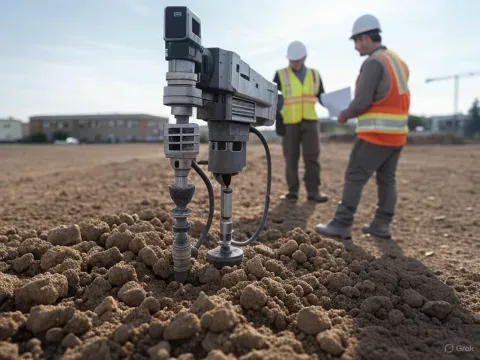
5. Interpretation of results and geotechnical report
Once the field and laboratory tests have been completed, the geotechnical team interprets and analyses the information obtained. From there, the geotechnical report is prepared:
-
Description of the ground: Includes the stratigraphic composition and hydrogeological conditions.
-
Design parameters: Resistance values, cohesion and friction angle, among others, are specified.
-
Foundation recommendations: The type of foundation (shallow, deep or piled/combined) is suggested to ensure the safety and durability of the structure.
-
Risks and special considerations: Possible threats are highlighted, such as the presence of groundwater, areas with expansive clays or zones of uncontrolled fill.
This report is of utmost importance for architects, engineers and contractors, as it defines the project feasibility and provides guidance for designing stable structures.
6. Foundation selection and structural design
Based on the data from the geotechnical study, the foundation solution that best suits the project is selected:
-
Shallow foundations: Ideal for soils with good bearing capacity and for smaller-scale construction.
-
Deep foundations: Applied in ground with weak near-surface strata, or when the building is large and requires greater stability.
-
Mixed or special systems: Used in cases where there are significant variations in the ground or very particular geological conditions.
In this way, the structural design is built on a solid and reliable foundation, minimising the likelihood of uneven settlement or failures in the building.

7. Conclusions and final recommendations
A well-executed geotechnical study is the key to ensuring that any construction is carried out on safe and durable foundations. Although it may involve an initial cost, in the long term it is an investment that avoids costly damage and provides the peace of mind of having the ground assessed by specialist professionals.
If you are considering starting a construction project, remember:
-
Commission a team of geotechnical professionals with experience and suitable equipment.
-
Don’t skimp at this stage: a good geotechnical study can make the difference between a successful project and one with future problems.
-
Make sure you review the geotechnical report in detail and follow the recommendations for the foundation and structural design.
Having a geotechnical study is, in short, an essential step for any safe and durable project. Don’t hesitate to contact us if you need more information on how to carry out or interpret a soil study before embarking on your next project!
Do you need a geotechnical study?
Request a no-obligation quote. We’ll advise you on the type of study you need.
- Studies signed by a licensed geologist
- Compliant with the CTE and Eurocode 7
- Coverage throughout Spain


Más de 1000 estudios realizados
Request a free quote
We can contact you via WhatsApp, phone, or email, whichever you prefer.


