What nobody tells you: why you need a ground study before building your home?
Have you ever wondered why some houses develop mysterious cracks or why certain projects end up costing twice as much as originally budgeted? The answer could be right under your feet.

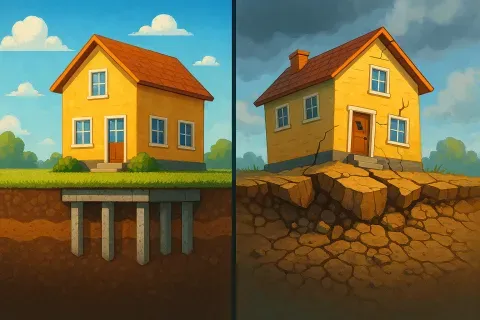
Your dream can turn into a nightmare if you ignore what lies beneath your feet
You’ve been saving for years. At last you have that plot of land where you’ll build the house of your dreams or extend your current home. You’re thrilled, imagining every corner, choosing materials and designing spaces. But there’s something crucial that many homeowners overlook: the ground on which your project will be built.
What is a ground study really, and why should you care?
A ground study (or geotechnical study) is like an X-ray of the ground where you will build. It may look like a simple bureaucratic procedure, but it’s much more: it’s your protection against unpleasant and costly surprises.
This study analyses what type of ground you have, how it will behave under the weight of your house, whether there is groundwater that could cause problems, or whether there are risks of settlement or landslides.
"Building without knowing your ground is like buying a car without looking under the bonnet. Everything may look perfect from the outside, but the surprises will come later." Juan Martínez, geotechnical engineer with 20 years of experience
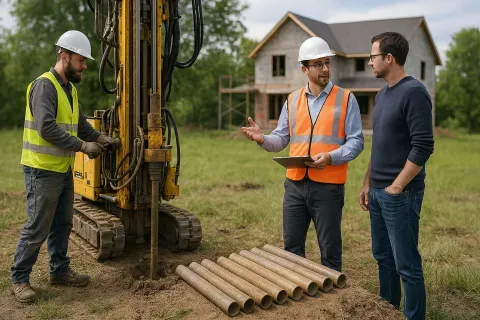
The 5 reasons you CANNOT skip this step
1. Because your pocket will thank you
"It’s just that a geotechnical study is expensive," Pedro told me, who wanted to build a two-storey house on the Mediterranean coast. Six months later he rang me in a panic: he had had to reinforce the entire foundation because the ground was far softer than his contractor had assumed "by eye".
The final cost: three times more than the initial study would have cost and a two-month delay on the build.
A ground study typically represents between 0.5% and 1% of your total construction budget. However, building with an inadequate foundation can drive costs up by as much as an additional 25%.
2. Because cracks are not just aesthetic details
Ana and Miguel had only finished their house two years earlier when they began to notice small cracks in the walls. "They’ll just be normal settlements," a friend told them. By the third year, some doors were no longer closing properly and the cracks had spread.
The problem: they had unknowingly built on expansive clay ground. This type of ground expands with moisture and contracts when it dries out, causing movements in the structure.
A simple ground study would have detected this problem and recommended an appropriate foundation for this type of ground.
3. Because every ground is a world
Your neighbour built without problems—so why should you worry? Because even on the same street, the subsoil can change dramatically.
José built his house based on his neighbour’s experience, just 50 metres away. What he didn’t know was that his plot was right over an old infilled gully containing poorly compacted material. The result: differential settlements left his house with a visible level difference.

4. Because the law is on your side (even if it doesn’t look like it)
The Spanish Technical Building Code (CTE) makes a geotechnical study mandatory for any building. It’s not a legal whim, but protection for you.
If you decide to skip this step, you should know that:
- Your architect or technician will probably refuse to sign the project
- You won’t obtain the municipal licence
- Your insurance may not cover damage arising from ground problems
- You could have legal responsibilities if damage occurs
5. Because you’ll sleep easy
Is there anything more reassuring than knowing your home has been built on solid foundations? The peace of mind that comes from having done things properly has no price.
What information will a good ground study give you?
When you receive your geotechnical report, you’ll find vital information such as:
- Type of ground: Whether it is clayey, sandy, rocky, or a mixture.
- Bearing capacity: How much weight the ground can support without deforming.
- Groundwater level: Whether groundwater is nearby and how it may affect your construction.
- Foundation recommendations: What type of foundations are most suitable for your case.
- Possible risks: Expansiveness, settlement, landslides or other potential problems.
All of this translated into language that you and your contractor can understand and apply.
The process: simpler than you imagine
Many homeowners avoid the geotechnical study thinking it is a complicated process or that it will delay their project. The reality is very different:
- Contact a specialist company: Look for references and request several quotations.
- Initial site visit: A specialist will visit your plot to plan the study.
- Fieldwork: Boreholes and tests will be carried out on your ground. This usually takes one or two days for a single-family dwelling.
- Laboratory analysis: The samples extracted are analysed to determine their properties.
- Final report: In approximately 1-2 weeks you will receive a complete report with clear recommendations.
From the first contact through to the final report, the whole process rarely exceeds three weeks.
Real cases: when the ground keeps secrets
The case of the housing development "Los Pinares"
A new housing development on the Valencian coast seemed like the perfect place for 12 families to build their summer homes. To save costs, the developer carried out a single general geotechnical study.
What that study failed to detect was a pocket of gypsum in a specific area, precisely where Carlos and Marta built their home. Two years later, the partial dissolution of this gypsum caused a collapse that affected the swimming pool and part of the terrace.
The lesson: even within the same plot, the subsoil can vary. A study specific to their lot would have identified this problem.
The miracle of the well-founded house
After the 2019 floods in the Murcia area, many houses suffered serious structural damage when the ground gave way due to saturation. However, the Sánchez family’s property, built only about a year earlier, remained intact.
The difference: they had carried out a complete geotechnical study that recommended a special foundation with deep piles, anticipating possible stability issues in the event of heavy rainfall.
Not all studies are the same: how to choose the right one?
There are different levels of geotechnical studies. For a typical single-family dwelling, a basic study that normally includes:
- 2-3 mechanical boreholes by rotary method
- Dynamic penetration tests
- Analysis of samples in the laboratory
- Foundation recommendations
However, if your ground is in an area with special characteristics (steep slopes, close to the coast, or in areas with a history of geological problems), you may need a more comprehensive study.
A good professional will advise you on the scope required without trying to sell you more than you actually need.
The right timing: before you fall too much in love with a design
The most common mistake is to design the perfect house and then carry out the ground study. What’s the problem? Sometimes the ground may not be suitable for certain types of construction.
Ideally, carry out the study:
- Before buying the plot (if possible)
- Definitely before finalising the house design
- Always before requesting licences or hiring building contractors
This allows the design to be adapted to the real ground conditions, optimising costs and ensuring safety.
Questions you should ask (and almost nobody does)
When you commission your geotechnical study, make sure you ask:
- How many investigation points (boreholes or penetrometers) will they carry out?
- How deep will the excavations reach?
- What type of tests does the study include?
- Will the report include specific recommendations for my type of construction?
- Do they offer follow-up advice if my architect or contractor has questions?
Conclusion: your house deserves good foundations
Your home is probably the biggest investment you will make in your life. Don’t skimp on what you can’t see but that supports everything else. A good ground study is the first stone of a solid, safe and durable house.
As the saying goes, adapted to the construction world: "Cheap can end up very expensive, especially when it’s beneath the ground".
Are you planning to build or extend your house? Don’t let ignorance of the ground turn your dream into a nightmare. A simple geotechnical study can make the difference between a house for life and a constant headache.
Your future home will thank you. And so will your peace of mind.
Do you need a geotechnical study?
Request a no-obligation quote. We’ll advise you on the type of study you need.
- Studies signed by a licensed geologist
- Compliant with the CTE and Eurocode 7
- Coverage throughout Spain


Más de 1000 estudios realizados
Request a free quote
We can contact you via WhatsApp, phone, or email, whichever you prefer.


