What is geotechnics? The invisible foundation of every construction
Geotechnics is the science that studies and develops techniques for the development of construction works in relation to the ground. Geotechnics or geotechnical engineering includes many sub-disciplines such as geology, soil mechanics, rock mechanics, hydrogeology, materials science and structural engineering. In this article, we will explore in detail what geotechnics is, its importance and how a good geotechnical study ensures the safety and efficiency of construction works.

Carrying out a geotechnical study before building is essential
Geotechnics is a fundamental discipline that often goes unnoticed by the general public, but it is essential in any construction project. When we look at a building, a bridge or a road, we rarely think about what is underneath: the ground that supports it. However, it is precisely this interaction between the soil and the structure that determines the safety, durability and feasibility of any construction.
In this article, we will explore what geotechnics exactly is, why carrying out a good geotechnical study before building is essential, and how this field of civil engineering protects us all in our day-to-day lives.
What is Geotechnics? Definition and scope
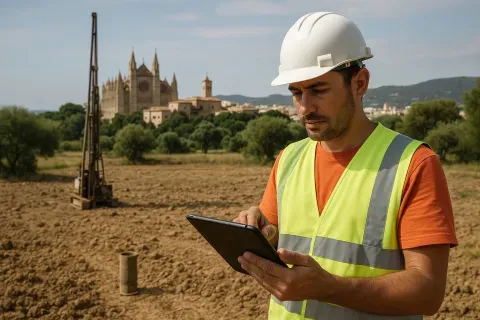
Geotechnics is the branch of civil engineering that studies the mechanical, hydraulic and physical properties of earth materials, especially soils and rocks, and their application to engineering problems. This field combines principles of soil mechanics, rock mechanics, geology and hydrology to analyse the interaction between structures built by human beings and the ground on which they are founded.
Unlike other engineering disciplines that work with manufactured materials under controlled standards, geotechnics deals with natural materials with heterogeneous and variable properties. A geotechnical engineer must:
- Determine the physical characteristics and behaviour of the ground
- Assess the bearing capacity of the soil
- Predict possible settlements and deformations
- Estimate the stability of slopes and excavations
- Recommend the most suitable foundation systems
- Identify and mitigate geological risks
History and evolution of Geotechnics
Geotechnics as a scientific discipline is relatively recent, although human beings have faced challenges related to ground conditions since the earliest constructions.
From empirical experience to modern science
For centuries, builders relied mainly on observation and accumulated experience to determine whether a ground was suitable for construction. The Romans, for example, developed advanced foundation techniques based on practical knowledge. However, it was not until the 20th century that geotechnics was established as a formal scientific discipline.
Karl Terzaghi, considered the “father of modern soil mechanics”, published in 1925 his work “Erdbaumechanik” (Soil Mechanics), establishing the theoretical foundations of the discipline. From then on, driven by the development of major engineering works and some notable structural failures, geotechnics experienced rapid development both in its theoretical framework and in research techniques.
The Geotechnical study: the cornerstone of safe construction
What is a geotechnical study?
A geotechnical study is an investigation of the subsurface that analyses and characterises the materials on which a construction will be founded. This study provides crucial information for properly designing foundations and other structures that interact with the ground.
Stages of a good complete geotechnical study
- Preliminary investigation: Compilation of existing information about the area (geological maps, history of nearby constructions, etc.)
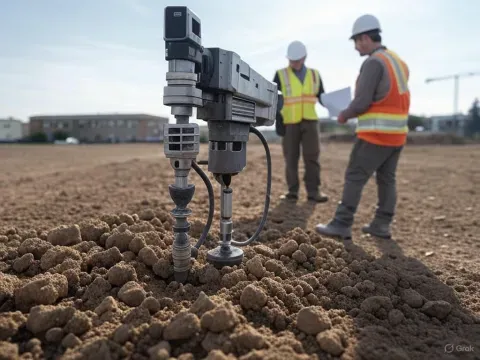
- Fieldwork: Carrying out boreholes, trial pits, penetration tests and other techniques to obtain samples and ground data.
- Laboratory tests: Analysis of the samples to determine properties such as gradation, plasticity, strength, compressibility, etc.
- Analysis and interpretation: Processing all the data obtained to characterise the ground and its behaviour.
- Technical recommendations: Proposal of construction solutions tailored to the specific conditions of the ground.
When is a geotechnical study mandatory?
In Spain, current regulations (Technical Building Code, CTE) establish the requirement to carry out geotechnical studies for practically any type of building. The extent and depth of the study vary depending on the complexity of the structure and the geological characteristics of the area.
Techniques and tests in geotechnical investigation
Field techniques
Geotechnical professionals have a wide range of techniques to investigate the ground:
Mechanical boreholes
They allow continuous samples of the ground to be obtained at different depths. There are various types:
- Rotary boreholes with core recovery
- Percussion boreholes
- Helical boreholes
Penetration tests
They measure the ground resistance to penetration by a standardised device:
- Standard penetration test (SPT)
- Dynamic penetration test (DPSH, DPH, DPM, DPL)
- Static penetration test or Dutch cone (CPT, CPTU)
Trial pits
Shallow excavations that allow direct observation of the ground and sampling.
Geophysical tests
Non-destructive methods that use physical principles to investigate the subsurface:
- Seismic refraction
- Electrical tomography
- Ground-penetrating radar
Laboratory tests
The samples obtained in the field are subjected to various analyses:
- Identification tests: gradation, Atterberg limits
- State tests: density, moisture content
- Strength tests: unconfined compression, direct shear, triaxial
- Deformation tests: oedometer, consolidation
- Chemical tests: sulphate content, organic matter, pH
Applications of geotechnics in different sectors
Residential and commercial building
In the building sector, geotechnics is fundamental for:
- Designing safe and economical foundations
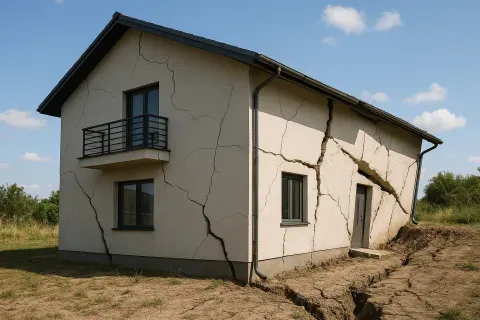
- Preventing structural damage caused by differential settlements
- Minimising the impact on neighbouring buildings
- Planning excavations and earth retention
Civil engineering works
Large infrastructures pose particular geotechnical challenges:
- Dams: stability, seepage, internal erosion
- Tunnels: rock mass behaviour, ground support
- Bridges: bearing capacity at abutments and piers
- Roads: slope stability, pavement behaviour
Special projects
Some projects require especially detailed geotechnical studies:
- High-rise buildings or with exceptional loads
- Construction in seismic zones
- Infrastructures on problematic ground (expansive, collapsible, karstic)
- Rehabilitation of historic buildings
Common geotechnical problems
Expansive soils
These soils undergo significant volume changes with variations in moisture. In Spain, they are particularly common on the central plateau and in the Guadalquivir valley. An appropriate geotechnical study allows them to be identified and enables the design of specific solutions such as:
- Reinforced and deep foundations
- Barriers against moisture changes
- Ground improvement treatments
Karstic ground
Karstic formations, characterised by the dissolution of limestone rocks and the formation of cavities, present risks of sudden ground collapse. Their detection requires:
- Advanced geophysical methods
- A higher density of recognition points
- Complementary hydrogeological studies
Slope instability
Ground slides can seriously affect constructions. Geotechnics makes it possible to:
- Assess the natural stability of the slope
- Design retention and drainage systems
- Monitor movements to detect early warning signs
Benefits of a good geotechnical study
Guaranteed safety
The main benefit is, without doubt, safety. A complete geotechnical study identifies potential risks and enables the design of solutions that guarantee the stability of the construction throughout its service life.
Economic optimisation
Although it involves an initial investment, a good geotechnical study allows construction solutions to be optimised, avoiding:
- Unnecessary oversizing
- Modifications during execution
- Costly repairs due to undiscovered problems
- Litigation due to damage to third parties
A study that costs between 0,1% and 0,5% of the total budget can save up to 20% in foundation costs and prevent problems that could multiply the final cost.
Sustainability and respect for the environment
Modern geotechnics incorporates sustainability criteria:
- Minimising earth movement
- Reusing excavated materials
- Low environmental impact ground improvement techniques
- Solutions tailored to the natural environment
How to choose a good geotechnical study service
Selection criteria
When commissioning a geotechnical study, it is advisable to assess:
- Experience and specialisation in similar projects
- Technical equipment available
- Own laboratory or accredited collaborators
- Ability to interpret and provide advice
- References from previous clients
Documentation and deliverables
A professional geotechnical study should provide:
- Complete descriptive report
- Annexes with field and laboratory test data
- Clear stratigraphic profiles
- Specific recommendations for the project
- Advice during the design and execution phase
Geotechnics as an investment in safety and quality
Geotechnics, far from being a mere administrative procedure or an additional expense, is a fundamental investment in the safety, durability and economy of any construction project. A rigorous geotechnical study provides the knowledge necessary to make the right decisions from the earliest phases of the project.
In a context where the most favourable ground has already been occupied and technical requirements are increasing, geotechnics becomes an indispensable tool for tackling the construction challenges of the 21st century. Relying on experienced professionals not only complies with current regulations, but also guarantees peace of mind in knowing that we are building on solid foundations, both literally and figuratively.
Remember: no construction is better than its foundations, and no foundation is better than knowledge of the ground on which it rests.
Do you need a geotechnical study?
Request a no-obligation quote. We’ll advise you on the type of study you need.
- Studies signed by a licensed geologist
- Compliant with the CTE and Eurocode 7
- Coverage throughout Spain


Más de 1000 estudios realizados
Request a free quote
We can contact you via WhatsApp, phone, or email, whichever you prefer.


