How much does a geotechnical study cost? The honest answer that nobody gives you
How much does a geotechnical study cost in Spain? Indicative prices, factors that make the study more expensive, and why there are no fixed rates. An honest guide for property owners.

price of geotechnical study
If you have searched online for the price of a geotechnical study, you have probably come across two types of answers. The first: round, reassuring figures that promise complete studies for 300 or 400 euros. The second: real quotations that land in your inbox and have nothing in common with those numbers. The gap between the two creates distrust, and that distrust leads many property owners to choose the cheapest option without understanding what they are buying.
The reality is more nuanced than either of those two versions. There are no fixed tariffs for geotechnical studies in Spain. There is no professional body that publishes an official, binding schedule of fees; there is no homogeneous market price; and there are no two plots that are exactly the same. What does exist is a set of well-defined factors that determine the real cost of each study, and knowing them allows you to interpret any quotation rationally rather than choosing blindly based on the lowest price.
Why there is no fixed price and what determines the real cost
A geotechnical study is not an off-the-shelf product. It is a professional service that combines fieldwork, laboratory analysis and technical interpretation, and each of those three components has a variable cost depending on the specific circumstances of each plot and each project.
The first component is travel and mobilisation. Spain is a large country and the geographical distribution of geotechnical studies is not uniform. A technician working from Madrid may charge a significant mobilisation fee to carry out work on a plot in Cuenca or Cáceres. This mobilisation cost — petrol, travel time, accommodation if the job day is long — is passed directly on in the quotation. In metropolitan areas with a high density of construction work, mobilisation is short and its impact on the price is minimal. In rural areas or provinces with less construction activity, it can represent between 15 % and 25 % of the total study cost.
👉 What does a geotechnical report include?
The second component is field machinery. Not all ground can be investigated using the same resources. A light dynamic penetration test (DPSH) is fast and economical. A mechanical borehole with continuous core recovery requires a drilling rig that costs between 80 and 150 € per metre drilled, only for execution. If the ground is hard, if there is rock, if you need to drill deeper than usual, or if access with heavy machinery is difficult, the field cost multiplies.
The third component is laboratory testing. Analysing the unconfined compressive strength of a sample, determining the expansive potential of a clay, or measuring the chemical aggressiveness of groundwater all have a unit cost per test. The more tests the complexity of the ground requires, the higher the laboratory bill.
"The price of a geotechnical study does not reflect the technician's ambition: it reflects the real complexity of the work your plot requires."
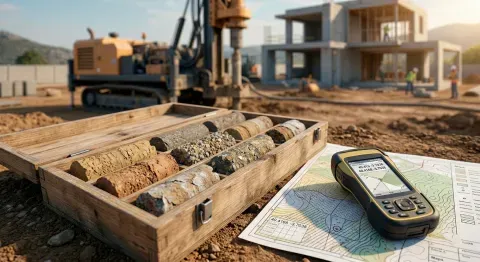
samples from geotechnical boreholes
Indicative prices according to the type of work
With all the warnings above regarding variability, these are the price ranges the market applies in Spain under normal conditions, without special cost-increasing factors and with reasonable travel from a nearby urban area.
Single-family dwelling of one or two storeys without a basement
This is the most common type of commission and the one that allows the tightest pricing. Three recognition points, depth between 6 and 8 metres, basic laboratory tests and a stamped (visado) report. Indicative range: between 800 and 1,800 €.
Single-family dwelling with a basement or semi-basement
The presence of a basement forces deeper boreholes and requires special attention to the groundwater level and the ground’s aggressiveness towards the concrete of the retaining walls. Indicative range: between 1,200 and 2,500 €.
Multi-family building up to four storeys
More recognition points, greater depth, more laboratory tests, and a more extensive report with parameters for detailed seismic design. Indicative range: between 2,000 and 5,000 €.
Plot in a rural area or with difficult access
Any of the cases above where mobilisation is more than 60 kilometres from the nearest urban core with technicians available, or where access for machinery is complicated. Add between 300 and 800 € to the corresponding range.
KEY DATA: The cost of a complete geotechnical study will usually represent between 0.3 % and 0.8 % of the total construction budget for a single-family dwelling. Proportionally, it is one of the smallest expenses in the construction process and one that has the greatest impact on the rest of the budget.
👉 How does the allowable bearing pressure affect the foundation budget?
Factors that increase the cost of a study beyond what you expect
There are specific circumstances that can push the price of a geotechnical study far above the indicative ranges above. Knowing them in advance prevents surprises when the quotation arrives.
Ground with rock present
Drilling through rock requires equipment with higher power, greater time consumption and greater tool wear. One metre of borehole in rock can cost three or four times more than one metre in soft ground. If the geological signs in the area indicate rock at shallow depth, the budget must take it into account from the outset.
High groundwater level
When groundwater appears at shallow depth, the boreholes require casing to prevent collapse of the drilling walls, and the testing becomes more complicated. In addition, if samples have to be taken below the groundwater level, the technique changes and the cost increases.
Plots with made ground or industrial history
A plot that has been a landfill, that hosted an industrial activity, or that has infill of unknown origin requires a higher number of recognition points, greater depth and additional chemical analyses to rule out contamination. In these cases, the geotechnical study may be combined with a contaminated soil characterisation study, which multiplies the cost.
Areas with high seismicity
In municipalities with high seismic acceleration according to NCSE-02, the geotechnical report must include specific parameters for seismic calculations that require additional tests, especially the determination of the shear-wave velocity in the subsoil. These geophysical tests have a significant cost that is not always included in a standard quotation.
Need for urgent stamping (visado)
Professional stamping has its own deadlines. If the project has a submission deadline and the stamped report is needed in less time than usual, some professional bodies apply urgent fees that are reflected in the final price.
👉 Who signs the geotechnical report, and why does that signature change everything?
The most expensive mistake: choosing based on price without reading the scope
In a promotion of terraced houses in the province of Toledo, the developer chose the cheapest geotechnical study among the three quotations that had been requested. The difference with the second cheapest was 600 €. The study was carried out, the report arrived and the project moved forward.
During the works, expansive clays appeared that the study had not detected because the boreholes had not reached sufficient depth. The chosen quotation included six-metre boreholes when the complexity of the area required at least ten. The 600 € saved on the study resulted in a redesign of the foundations with a reinforced raft slab, which involved an extra cost of 31,000 €, split across the four dwellings in the development.
The difference between the cheap quotation and the appropriate one was not the final price: it was the scope of the work included. The number of boreholes, the depth of each, and specific laboratory tests for clays. Data that were included in the work schedule (scope) of each quotation and that no one read before deciding.
👉 How many boreholes does my plot need for the geotechnical study?

Geotechnical Analysis Laboratory
Three questions you must ask before accepting any quotation
When you receive a geotechnical study quotation, do not judge it only by the final figure. Before you decide, ask this:
- How many recognition points does it include, and to what depth? A low-cost quotation with two five-metre boreholes may be insufficient for your plot. Compare the scope, not just the price. If you do not know how many boreholes you need, consult your architect first or read the regulations applicable to your type of work.
- What laboratory tests are included? The price of fieldwork without laboratory testing is like a medical analysis performed without processing the samples. Check that the quotation includes at least the basic tests: particle size distribution, Atterberg limits, compressive strength and chemical aggressiveness analysis if there are indications of groundwater.
- Does the price include professional stamping (visado)? Some quotations specify stamping as a separate item, while others include it in the total. Make sure you compare quotations with the same scope, including stamping, because without it the report may not be valid to attach to the execution project.
"Saving 600 € on the geotechnical study and paying 31,000 € on the works is not bad luck: it is the predictable consequence of choosing based on price without comparing the scope of the work."
How much it really costs not to commission it
There is a way to calculate the cost of a geotechnical study that few people use, but which puts everything into perspective: comparing it with the cost of not having it.
An oversized foundation due to lack of data can cost between 15,000 and 30,000 € more than necessary. An insufficient foundation can generate structural defects whose repair frequently exceeds 40,000 €. A project rejected by the town hall due to lack of geotechnical documentation results in weeks of delay and additional fees for all the technicians involved.
Against those figures, the cost of a properly carried out geotechnical study — between 900 and 2,500 € for most single-family dwellings — is not an expense. It is the investment with the best return ratio of the entire construction. And now that you know the factors that determine that price, you are in a position to request a quotation rationally, compare intelligently and decide knowing exactly what you are contracting.
Request a geotechnical study quotation via form →
Do you need a geotechnical study?
Request a no-obligation quote. We’ll advise you on the type of study you need.
- Studies signed by a licensed geologist
- Compliant with the CTE and Eurocode 7
- Coverage throughout Spain


Más de 1000 estudios realizados
Request a free quote
We can contact you via WhatsApp, phone, or email, whichever you prefer.


