Geotechnical study in Plenas
Do you need a Geotechnical study?
Find the best price and service in Plenas. Get a free quote.
More than 1000 geotechnical studies carried out
Get personalized attention
We can contact you via WhatsApp, phone, or email, whichever you prefer.
Comprehensive Geotechnical Studies
We combine field analysis and laboratory testing to provide accurate technical reports and foundation solutions.


Expert professional
Technicians with more than 15 years of experience in the industry. We are specialists in access to difficult locations such as sites with level changes, basements, etc.
Accredited
Geotechnical calculations comply with the rules established by Eurocode 7, UNE-EN ISO 22476-4:2016.

Explora el terreno bajo tu casa
Best price
Very competitive prices. The best prices for geotechnical studies in Spain. Request a quote and check it.
Speed and quality
Within 7 to 10 days you will receive a signed report from a geologist. It is mandatory in order to carry out new construction or refurbishment works that involve modifications to the structure.

Work areas
We provide Geotechnical study services in all the towns and villages of Plenas.
This includes the following geographical areas: Province of Huesca, Province of Teruel, Province of Zaragoza, Aragón and the surrounding areas.
We’ll come to your home in Plenas at a time that suits you, arranging a day and time.

Types of ground in Plenas
Sandstone, conglomerate and flysch outcrops predominate in Plenas, with localised occurrences of white or soft expansive clays and, to a lesser extent, limestone, dolomite, marble, gravel and dense sand. The bearing capacity and foundation solution will depend on the continuity, degree of weathering and arrangement of these materials, as well as the possible presence of clay layers; the aquifers mapped as highly permeable, extensive and productive also make it advisable to check the water conditions on the site. The geotechnical study must characterise the ground before defining the bearing stratum and foundation type.
The mapping indicates locally predominant expansive clays, so there is a clear risk of volume changes that must be assessed at the site. It also records gypsum, anhydrite and salts, associated with a possible dissolution risk, and the presence of karst, which must be verified before foundations are laid. No municipal seismicity data are available: the cited record relates to the province of Zaragoza and must not be attributed to Plenas or used on its own to infer structural design requirements. The regional information is indicative; the main constraint will be confirming the distribution of expansive clays and the possible presence of dissolution or cavities on the site.
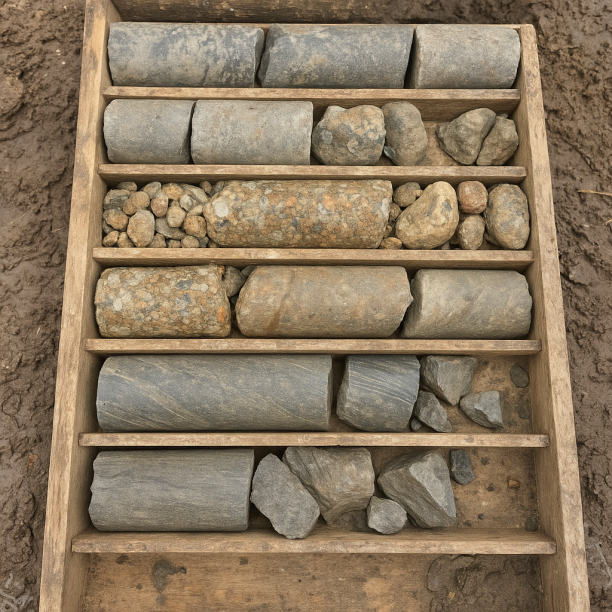
Sandstones, Conglomerates and Flysch
Sedimentary rocks formed by the cementation of fragments of other pre-existing rocks. They include sandstones (cemented sand), conglomerates (cemented gravels) and the rhythmic alternation of sandston
View details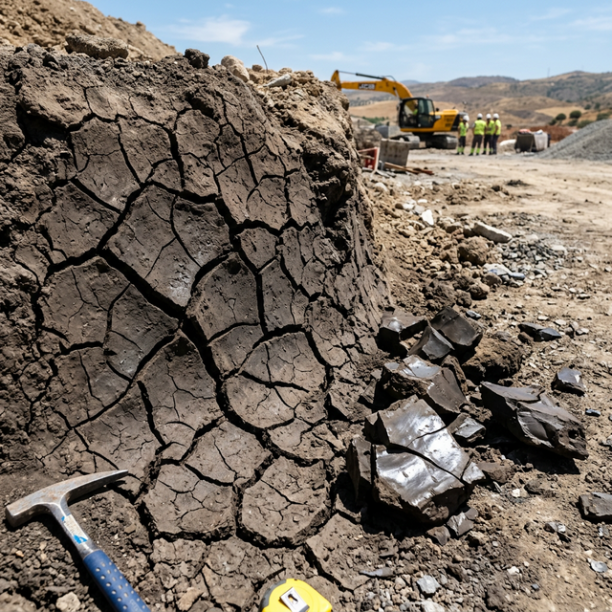
White/Soft Expansive Clays
The great queens of pathology in civil building in Spain. They are frequently found in the lands of barros of Córdoba and Badajoz, the vegas of the Guadalquivir (Mairena, Carmona), the Miocene basin o
View details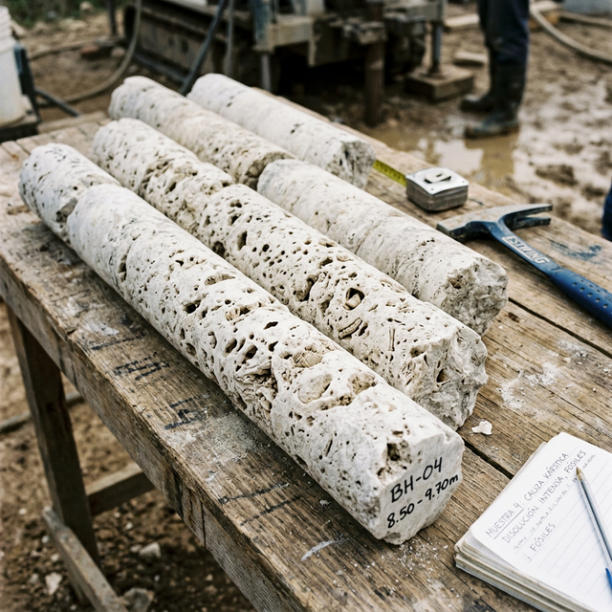
Limestones, Dolomites and Marbles
karstic structures (caves, sinkholes, dolines) that pose the main geotechnical risk.
View details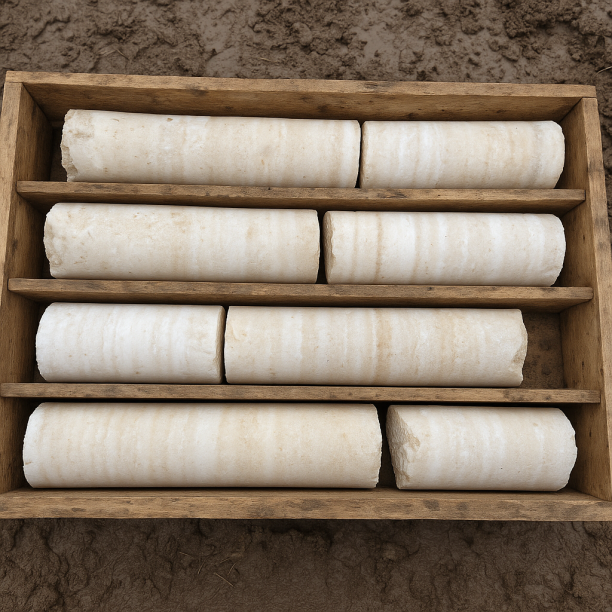
Gypsum, Anhydrite and Salts
Chemically formed sedimentary rocks produced by the precipitation of minerals dissolved in closed basins. Gypsum predominates (calcium sulphate) and, to a lesser extent, anhydrite and salts (halite).
View details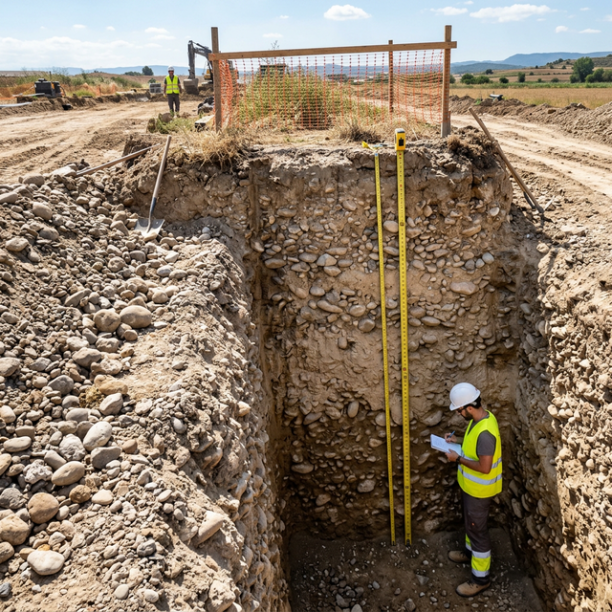
Compact gravels and sands
High-compacity granular deposits, typically associated with old fluvial terraces (Ebro, Duero, Tajo, Guadalquivir rivers) and Pleistocene glacis. They have no cohesion (they are not clays) but their a
View detailsConstruction risks in Plenas
Approximate estimates. They do not replace the geotechnical study.
| Soil type | Expansivity | Settlements | Water table | Seismicity | Minimum foundation |
|---|---|---|---|---|---|
| Sandstones, Conglomerates and Flysch | None | Media | Media | Media | Direct foundation is feasible in most cases. For flysch ... |
| White/Soft Expansive Clays | High | High | Downward | Downward | Inviable the pure shallow isolated footing. Either a sym... |
| Limestones, Dolomites and Marbles | None | Media | Media | Downward | In general, direct foundation using braced strip footing... |
| Gypsum, Anhydrite and Salts | Media | High | High | Media | The foundation must be designed to withstand local loss ... |
| Compact gravels and sands | None | Downward | High | Downward | Conventional shallow foundation without problems. Raft f... |
Interactive geological map · Plenas
Mapping: IGME GEODE 50k · IGME MAGNA 50 · ICGC (Catalonia)
Geological Viewer
IGME · ICGC- Click on the map to see the geology at the point.
- Use the layer buttons to switch between geological views (GEODE, MAGNA, Lithology, Hydrogeology).
- Adjust the opacity of the geological layer with the control below.
- Press the full-screen button to expand the viewer.
Geological information
Typical stratigraphic profile
Indicative subsurface cross-section in Plenas · Based on GEODE soil types
Indicative profile based on GEODE soil types and typical CTE thicknesses
Seismic risk in Plenas
Seismic risk is assessed at municipal level. These are aggregated data for the area.
- 1 M 4.8 2007
- 2 M 2.8 2006
- 3 M 2.4 2022
How do we carry out your geotechnical study?
Step
Free quote
Request a quotation for your geotechnical study. Completely free and with no obligation.
Step
We arrange a day
We are looking for a day and time to carry out the field study.
Step
Conducting the geotechnical study
We’re going to move and carry out the study. In an hour or two we’ll have finished.
Step
Report submission
Within a week we will send you the signed documents of the geotechnical study by an accredited geologist.
Nearby locations
Geotechnical surveys near Plenas
Useful information about Geotechnical study
In-depth articles


Entities and institutions